

The Pax Americana DLC for Maestro's Cold War 2 launches on Steam on March 19th. This expansion pushes the turn-based grand strategy game past the Cold War's end and into the volatile 1990s and early 2000s, adding four new scenarios covering events like the First Gulf War and the Y2K Scare. Players can take the reins of either the United States, working to secure a unipolar global order, or the USSR, attempting to rewrite history and prevent the Soviet Union's collapse entirely.
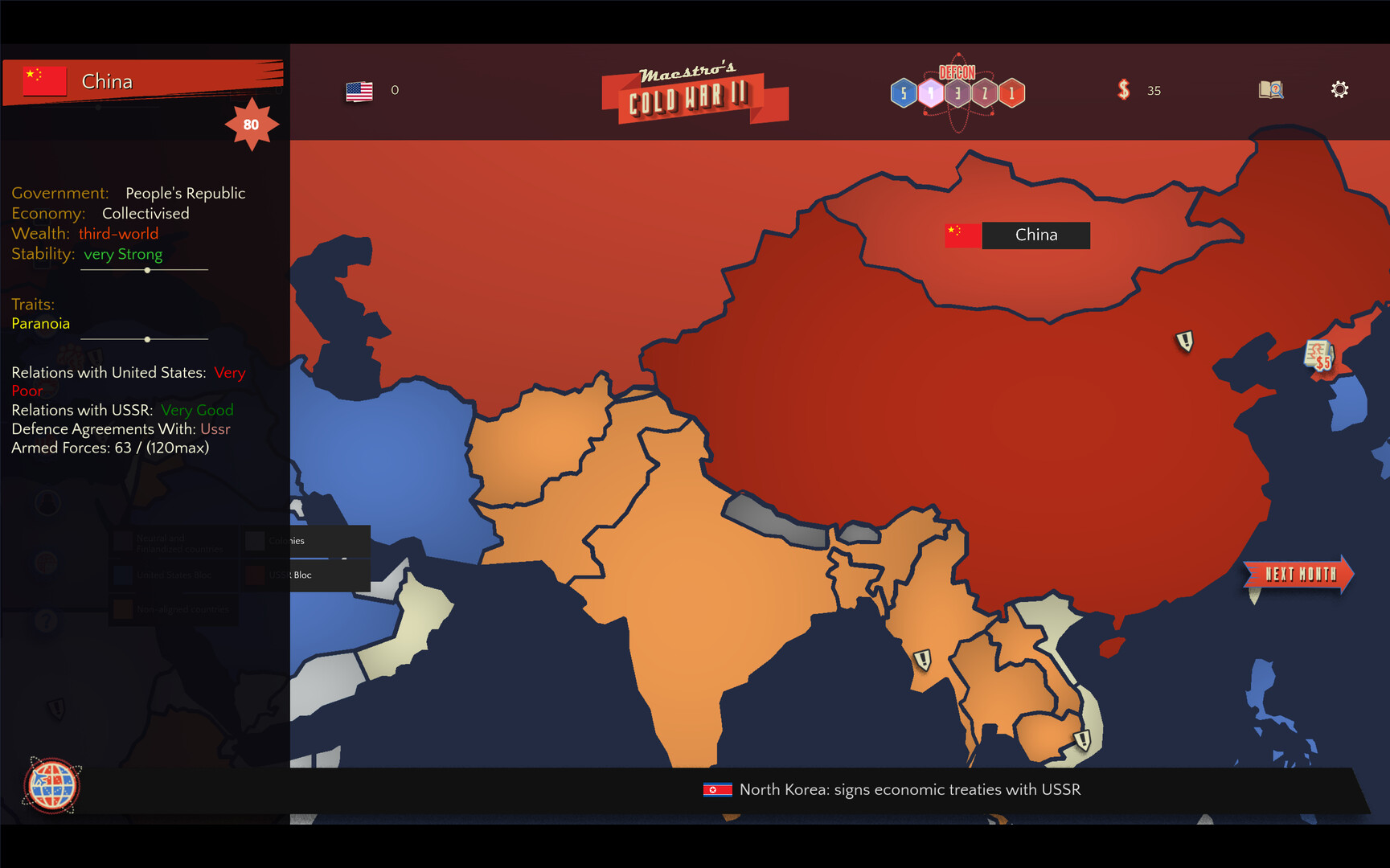
The base game built itself around a single clear objective: earn more prestige points than your rival superpower. Every turn represents a month of budget to spend, and the interactive map is where that budget does its work. Offer military or economic aid to improve relations with other countries, then push for trade deals and defence treaties that lock in prestige gains. Countries pulled into your sphere of influence double both prestige gains and losses, making them valuable but volatile. Subversions let you divert attention or attempt to overthrow governments aligned with your rival, but aggression carries real weight. Push too hard and the DEFCON meter climbs, dragging both sides toward nuclear confrontation. The tension between expanding influence and managing escalation sits at the centre of every decision. Pax Americana adds a new Hubris scale specifically for the U.S., introducing another variable to track as American power extends into the post-Cold War vacuum. New interactive map events also arrive with the DLC, including The War on Terror and The War on Drugs, where players investigate drug cartels and terrorist cells before they spiral into larger threats.
Maestro Cinetik, the solo developer behind the game, describes himself as a punk-rock creator focused on deep historical strategy about power, ideology, and the people who shape history. His previous release, Rise of the White Sun, established the studio's appetite for politically charged subject matter. Playing as either superpower means committing to a worldview and then bending the global map to match it, whether that means propping up allied governments or quietly dismantling hostile ones. The game frames the Cold War not as a military conflict but as a contest of influence, where the real battlefield is every nation caught between two competing visions of the world.
The premise is straightforward: the longest arms race standoff in history, compressed into a format designed to be played in a single evening but with enough depth to pull players back repeatedly. The DLC's new scenarios extend that timeline into historically defining moments that followed the Cold War's conclusion, letting players explore what happens when one superpower appears to have won and the other refuses to accept it. New achievements tied to the expansion include carrying the Soviet Republics into the 21st century and preventing the terrorist attacks of 9/11.
Players can approach the game through smaller historically focused scenarios or commit to a 50-year grand campaign that stretches across the full timeline. Online multiplayer lets two players choose opposing blocs and test their strategies against each other directly. The base game received highly positive reviews on Steam, and Pax Americana builds on that foundation by pushing into a period where the rules of superpower competition were being rewritten in real time. Each turn still comes down to the same core question: spend wisely, expand carefully, and decide how much risk you're willing to absorb before the DEFCON meter makes the decision for you.