

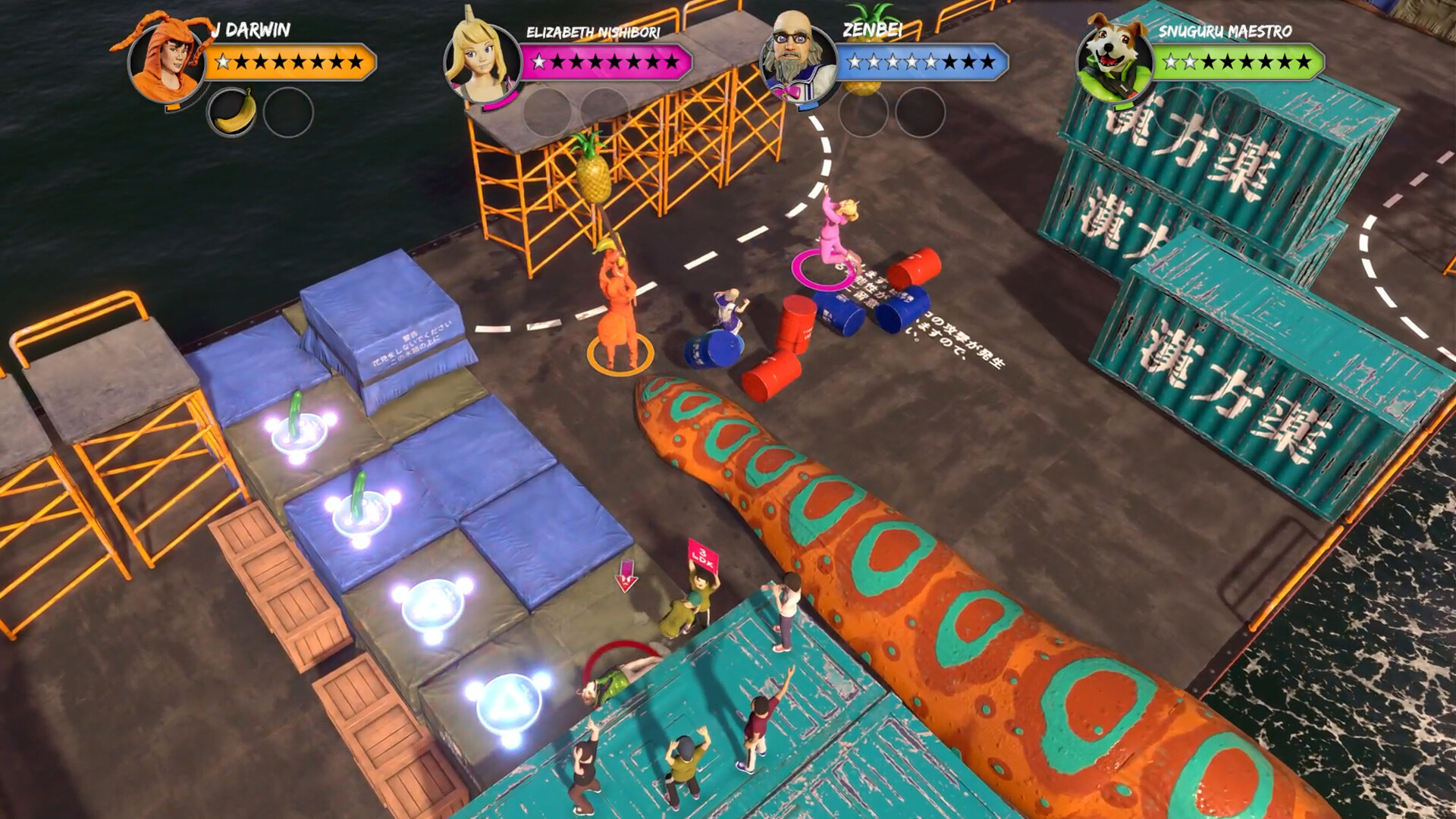
Nippon Marathon 2: Daijoubu is a four-player racer from Onion Soup Interactive that channels the frantic energy of Japanese variety television into obstacle-packed courses where players trip, tumble and hurl fruit at each other in pursuit of victory. Up to four contestants barrel through stages inspired by Japan, dodging everything from startled deer to giant octopuses while dressed in whatever absurd outfit the game's character creator can conjure. The sequel was built from the ground up with tighter controls and more responsive movement, treating platforming as a core part of the experience rather than an afterthought.
The courses themselves are dense with hazards and split into multiple paths that force constant decision-making. Yolko Harbour sends contestants through a construction zone filled with reckless forklift drivers and scissor lifts that open up shortcuts, past sailors swinging enormous anchors, and toward a giant octopus with a grudge against a cargo freighter. Shika Shika Deer Town winds through bamboo forest and past a high-speed scenic train before threading through Shikakuji Temple, where the local deer startle easily and kick with real force. The Ramen Museum takes a different approach entirely, routing players through a cup-noodle company's multimedia installations while dodging mascots and hordes of school children before funnelling them into a packing area where conveyor belts and machinery threaten to end the run. Each stage offers branching routes that reward different skill levels and strategies.
Fruit serves as the game's arsenal. Pineapples let contestants float over hazards or carve new shortcuts. Bananas can be dropped behind to trip rivals. Melons track their targets with heat-seeking chaos, capable of detonating gas tanks or hitting spectators who then blame the nearest contestant for the impact. Cucumbers deliver a spin attack that clears opponents and controls spacing, while mushrooms leave behind a purple cloud that drains popularity. Every item can also simply be eaten for a speed boost when the situation demands it, turning each pickup into a tactical choice between offense, defense and raw acceleration.
A new stamina system adds another layer to the chaos. Taking hits from opponent items, explosions or Shiba Inu bites drains stamina, as does sweating. When it runs out, a contestant becomes exhausted, their abilities temporarily weakened until they find safety and let it regenerate. Eating items replenishes stamina too, which means that banana you were saving to sabotage a rival might be better spent keeping yourself in fighting shape.
Winning a marathon isn't simply about crossing the finish line first. The scoring system rewards multiple styles of play through a combination of stars earned when other contestants are eliminated, finishing position points, popularity percentage and special badges like "Most Bitten" or "Smelliest Player." Popularity is gained by waving to spectators or performing crowd-pleasing actions such as releasing water from fire hydrants, and it translates directly into final score points. In cup mode where multiple stages are played back to back, popularity is the only score that carries between stages, making it a persistent resource that can be cultivated or squandered.
Each contestant carries individual stats across four categories: acceleration, recovery, acrobatics and stamina. These subtle differences give advanced players room to find depth beyond the surface-level mayhem, matching their playstyle to a character whose strengths complement it. The contestant creator expands this further with trillions of possible combinations spanning heads, bodies, hair, moustaches, hats, clothes, backpacks, tails and voices, with up to twenty custom contestants saved via Steam Cloud.
Super hazards function as something close to mini-boss encounters scattered across the courses. A flying yokai crow-person swoops in to attack. The giant octopus from Yolko Harbour emerges for a direct confrontation. These moments punctuate the races with threats that demand more than just staying ahead of the pack. A photo mode lets players pause the action and frame these encounters up close, capturing the chaos for sharing online or simply getting a better look at the posters, signs and easter eggs hidden throughout each stage.
The soundtrack features original compositions from returning composers, while sound effects draw from anime-style impacts inspired by the likes of One Piece, Dragon Ball Z and Pokémon. A returning commentator named Sora provides running commentary throughout. The game is heading into early access with single marathon versus and cup versus modes, supporting both human and CPU opponents. Additional modes and features remain in development, along with four more items yet to be revealed. For a game built around the spectacle of contestants being chased through town by Shiba Inu while wearing a lobster onesie and clutching a melon, Nippon Marathon 2 appears committed to making every second of that sentence playable.